
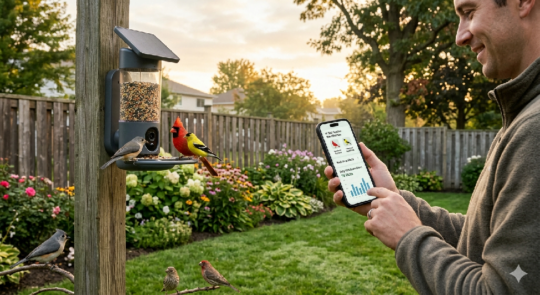
In 2026, smart homes are no longer associated with the ability to control lights, locks, or appliances. They are currently turning out to be a means of connecting people with nature by using AI-powered and eco-friendly technology, which is also being emphasized at CES 2026.
This is significant since North America has lost almost 3 billion birds since 1970, with 75 percent of the species declining, and grassland birds decreasing 53 percent. These statistics demonstrate why enhanced daily environmental awareness is important.
The AI bird feeder is an innovation in the smart home that has created a new, low-energy, and environmentally friendly birdwatching, learning, and more connected to nature space in an ordinary backyard in this dynamic environment.
The Limits of Traditional Birdwatching and Environmental Monitoring
Birdwatching has always been beautiful and charming. Individuals are sitting close to a window, have binoculars, are watching a feeder, and are attempting to see the various birds coming in. That experience is somehow serene and intimate. But it has its actual limits, too. It takes time and relies on patience. It relies on the fact that it is there in time.
A bird can come and land in a few seconds and go away. No one is on the lookout; the visit is missed. Sighting may not be clear in case of poor light. Even a keen eye will be confused in case two species resemble each other. This is enjoyable when it comes to traditional birdwatching, but can also be lengthy, subjective, and incomplete.
The same issue is observed on a larger scale in environmental monitoring. A high amount of field information is required by scientists to comprehend the bird populations, the changes in the habitat, the migration paths, and the impacts of climate change. Hence, human sight can’t be sufficient for the ground. It is excessively discontinuous. One individual can document a couple of visits in a single yard. The other can only watch on weekends. Another can cease after a brief time.
This is where AI changes the picture. Birdfy works with a high-definition camera, motion recording, AI recognition, and phone notifications, so it can be watched all the time, rather than just when an individual is in proximity. Birdfy claims that its system is capable of detecting over 6,000 bird species. It can automatically capture a brief video of every visit, provide real-time species notifications, categorize clips by species, and monitor visit counts by day.
The efficiency gap between human watching and AI-supported watching is easy to understand. A person may only notice birds in the morning before work or in the evening after coming home. But birds can visit throughout the day. AI can keep watching even when nobody is standing at the window. It can store records without forgetting, missing, or guessing. It can turn many short visits into usable data.
Citizen science programs already prove the value of this kind of steady observation. Project FeederWatch invites people across the United States and Canada to count birds visiting backyards and community spaces, and those observations help researchers track bird populations over time. A smart feeder makes that kind of observation easier, more regular, and more detailed for ordinary households.
AI, Citizen Science, and Birdfy’s Role in Environmental Monitoring
Birdfy becomes even more important when we look at its role in citizen science. The device is useful because it allows people to see birds more easily and helps create records that can show patterns over time. Birdfy bird feeders can track species, visit frequency, and trends by day, week, or season.
These smart feeders can also create daily highlight videos and monthly or yearly recaps. This means users are not just collecting random bird pictures. They are building a timeline of activity in their own yard. That makes it easier to notice seasonal shifts, new visitors, and changes that may be linked to weather or habitat conditions.
This kind of information becomes more powerful when it connects with larger scientific platforms. Projects, like eBird and iNaturalist, depend on many observations from many people. The strength of those systems comes from scale. A single backyard may seem small, but thousands of backyards together can reveal very important trends.
eBird Status and Trends provide the most detailed picture of bird populations available and support powerful new insights to reverse bird declines. It also uses weekly abundance animations to show migration paths and where birds are most common through the year, assisting in guiding conservation action. When people share observations from AI-supported feeders, they help close gaps in urban and suburban biodiversity data that formal field studies may miss.
Birdfy fits naturally into this growing model of AI-assisted citizen science. Its tools lower the barrier for beginners. A person does not need deep birding knowledge to begin. The system aids with identification, capturing HD images, classification, and alerts.
This matters because many people are interested in nature, but feel unsure about species names or birding skills. AI turns curiosity into action. It takes a casual interest and turns it into a repeat observation. That is how backyards start becoming what we can call micro-observatories, small places that quietly produce useful environmental knowledge over time.
Birdfy also highlights low effort and low energy use in its product story. Its own product material describes AI recognition, real-time alerts, video capture, and bird journals, while recent Birdfy materials also promote solar-powered use on some models.
This supports the idea that a backyard device can operate in a more eco-friendly way without demanding constant charging or heavy maintenance. When combined with smarter seed use and less waste, that helps position the AI bird feeder as part of a more sustainable smart home future.
To make this role even clearer, Birdfy’s contribution can be understood in three simple ways:
-
Captures more than people can capture alone
Captures more than people can capture alone
Bird visits happen quickly and often. AI can watch all day and record what a person would miss.
-
Turns sightings into patterns
Turns sightings into patterns
Instead of one nice photo, users get logs, trends, counts, and recaps that show how bird activity changes over time.
-
Helps everyday people join real science
Helps everyday people join real science
Citizen science platforms, such as eBird and Project FeederWatch, rely on public observations to improve understanding of bird populations and migration.
This is the broader impact of AI-assisted backyard birding. It increases both volume and accuracy of observation. It makes learning easier. It makes monitoring more regular. It helps connect private spaces with public knowledge. And, it gives people a direct role in environmental awareness at a time when bird populations are facing serious pressure. That is a powerful combination.
Conclusion
The AI bird feeder represents something bigger than a new backyard product. It is a bridge between smart home technology and sustainability. It shows how a small device can do more than offer convenience. It can support low energy use, reduce waste, improve wildlife observation, and help create valuable environmental records. In a time when North American bird populations are under major stress, that kind of everyday innovation matters.
Birdfy shows what the next stage of smart living can be. These are not only about smarter rooms and smarter appliances but also about smarter attention, using technology to look outward, not only inward.