
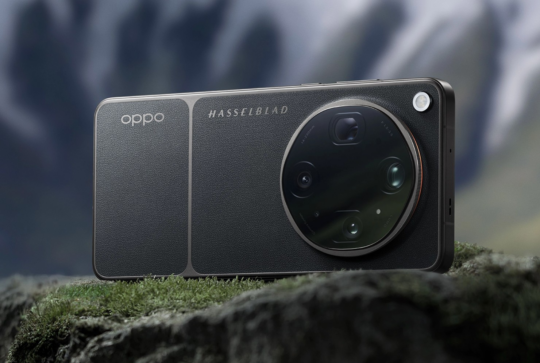
The OPPO Find X9 Ultra landed in the UK on 8 May 2026, priced at £1,449 for the 12GB/512GB configuration. Part of OPPO’s flagship Find X9 series, it sits above the Find X9 Pro and Find X9s, and carries the brand positioning of “Your Next Camera” — yet a closer look at the specifications reveals a device that extends far beyond photography.
This is the first time an Ultra-tier Find X phone has gone on sale outside China. Every previous Ultra model, including the Find X8 Ultra, stayed firmly within Chinese retail. That fact alone changes the conversation.
For professionals who rely on AI meeting transcription, real-time documentation, and seamless cross-device productivity, the Find X9 Ultra positions itself as one of the most capable executive smartphones currently available.
Built for the Boardroom
Modern professional environments demand a device that goes beyond raw speed, requiring hardware that seamlessly transitions from early-morning virtual meetings to evening networking events without missing a beat.
The OPPO Find X9 Ultra has been designed with exactly this kind of executive pace in mind. The Tundra Umber finish, which draws direct inspiration from the Hasselblad X2D 100C Earth Explorer Edition, combines a metal frame with textured matte eco-leather. A floating ring finished in iconic Hasselblad orange circles the camera module — the kind of visual signature that reads as intentional rather than ostentatious. The resulting aesthetic leans heavily into understated professionalism, setting it apart from the flashy designs often found in other premium tiers.
AI Recording: AI Meeting Transcription
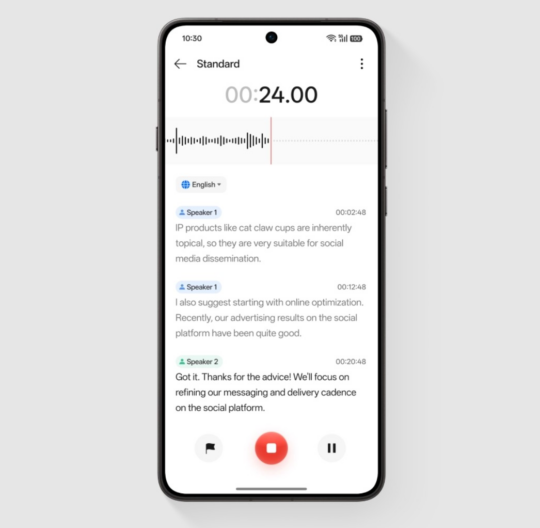
Beyond the premium hardware, the device’s strongest asset in a corporate context is its handling of meeting documentation via AI Recording. The system transcribes conversations in real time, identifies individual speakers, and auto-generates titles, tags, and chapters — turning a 90-minute strategy session into a structured, searchable document without the need to replay a single second. Replacing the tedious process of scrubbing through an hour of raw audio to find one specific quote, the on-device transcription turns lengthy meetings into instantly actionable text.
In roles that require constant context-switching and detailed record-keeping, having a built-in AI assistant for transcription has shifted from a luxury to an absolute necessity. AI Recording addresses this directly, and with enough precision to make it a genuine selling point rather than a checkbox feature.
These capabilities make the Find X9 Ultra particularly well suited for AI meeting transcription, executive note-taking, client meetings, and other productivity-focused professional workflows.
Connectivity Between Devices
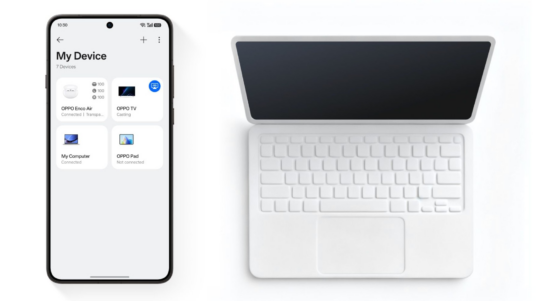
The “Your Devices, Perfectly in Sync” ecosystem sits quietly in the background but turns out to be one of the more practically useful aspects of the Find X9 Ultra. With the O+ Connect app, Touch to Share enables instant file transfers between OPPO and Apple devices locally — no internet connection required. Sharing a portfolio PDF or digital business card at a networking event takes a tap. PC Connect, which mirrors the phone directly onto a MacBook, removes a surprising amount of friction from back-to-back desk and meeting-room work.
These are the kinds of features that do not photograph well for marketing decks but consistently show up in how productive the device actually feels across a full working day.
Front Camera and Remote Presence
The 50MP front camera — with a 1/2.75-inch sensor, f/2.4 aperture, and 4K 60fps video recording — brings a level of optical quality to video calls that remains uncommon even among premium Android devices. For remote investor pitches and video conferences, where the frame you put forward can shape perception as much as what you say, this specification gap over a standard selfie camera is genuinely worth discussing.
The Find X9 Pro, by comparison, carries a standard front camera setup without the enlarged sensor. That distinction becomes clearer once you are aware of it.
The Camera System (In Brief)
Five cameras at the back include a 200MP f/1.5 main sensor, a 200MP 3x telephoto with a 1/1.28-inch sensor, a 50MP ultra-wide at 123 degrees, and an industry-first 50MP 10x periscope telephoto using OPPO’s Quintuple Prism Reflection Periscope Structure. A dedicated True Color Camera with 24 spectral channels handles real-time color calibration across every lens. 8K 30fps recording, an ACES-certified color pipeline, and support for Hasselblad’s cinematic LUT system round it out.
Compared to the Find X9 Pro — which carries a 50MP main sensor, Dimensity 9500 chip, and a 7500mAh battery (larger than the Ultra’s 7050mAh) — the X9 Ultra steps up with the Snapdragon 8 Elite Gen 5, a QHD+ 144Hz display (versus the Pro’s 120Hz), and the added 10x telephoto. The Pro has stronger battery endurance; the Ultra wins on camera range and processing headroom.
A Few Observations
At 236g, it is undeniably heavy for prolonged handheld use. That physical bulk is the mandatory trade-off for housing the massive 7050mAh battery and the complex dual-periscope camera module.
The Hasselblad collaboration is not window dressing. The colour science, tonal processing, and shooting interface reflect a genuine co-engineering relationship — and for a device positioned at the top of the Find X9 range, that pedigree matters.
Whether the Find X9 Ultra earns its place as a daily driver depends entirely on individual workflow requirements. For those whose working days run on sharp communication, real-time documentation, and professional presence across digital and in-person settings, the answer is fairly clear.